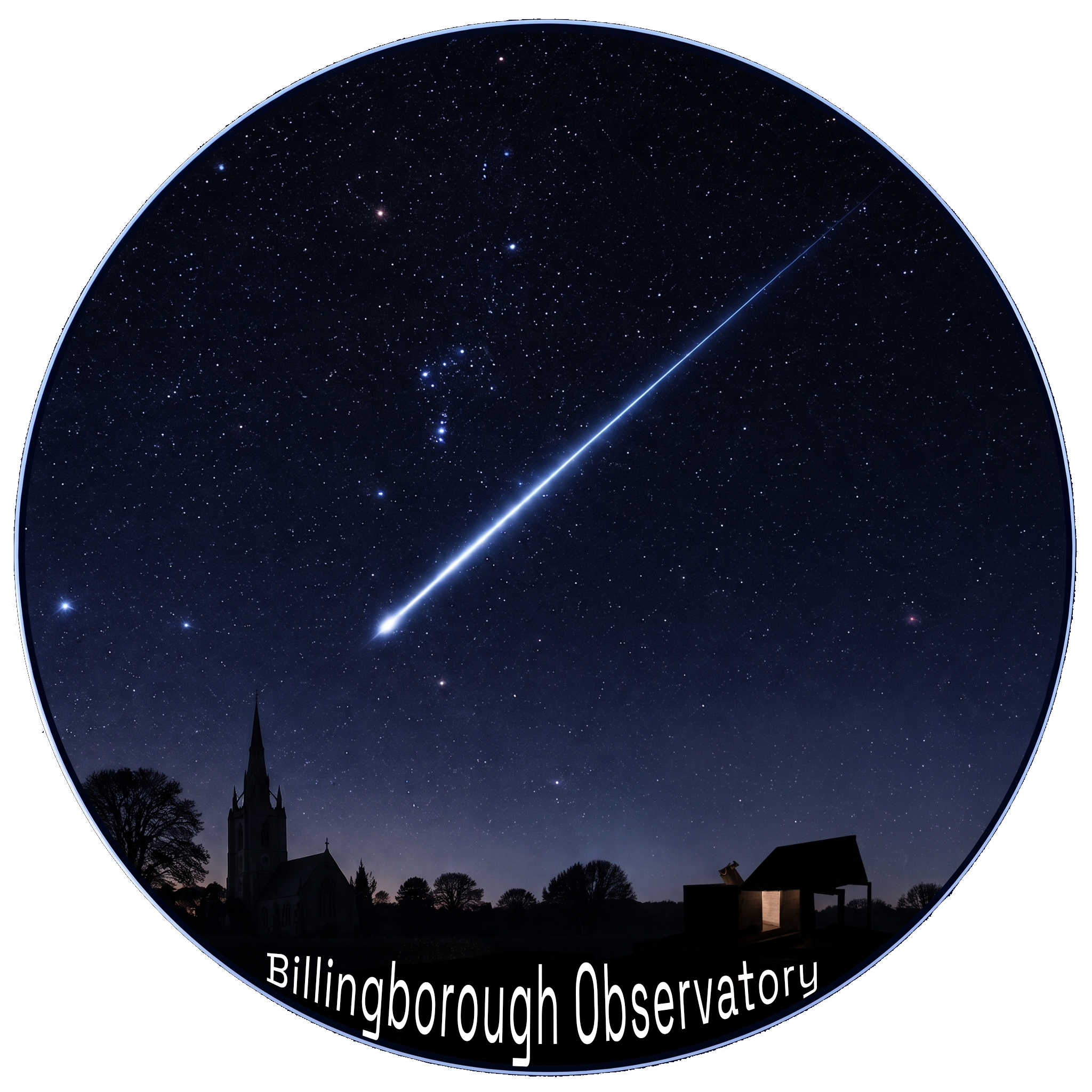
Timelapse
A sequence of photographs can be combined into a video, allowing the changing sky throughout the night to be viewed as a continuous moving sequence.
Watch the latest timelapse →LEARN & EXPLORE
How a single camera can watch the sky throughout the day and night, recording the changing conditions above Billingborough Observatory.
An AllSky camera is designed to capture an extremely wide view of the sky. Rather than pointing at one particular object, as a conventional astronomical telescope does, an AllSky camera watches the sky above it continuously.
The camera uses a very wide-angle lens, producing the characteristic circular view in which the horizon surrounds the edge of the image and the sky occupies the centre.
This makes an AllSky camera particularly useful for observing changes in the sky over long periods. Instead of seeing only what happens during a short observing session, we can build up a continuous record of conditions above the observatory.
BILLINGBOROUGH OBSERVATORY
Our AllSky camera operates automatically, capturing images throughout the day and night. The individual images become the raw material for several different ways of exploring the sky.

Current view from the Billingborough Observatory AllSky Camera.
LOOKING UP
Every image contains far more information than might initially be obvious. Depending on the time of day and the conditions, the camera can record clouds, sunlight, twilight, stars, the Moon, aurora and other changes in the sky.
At night, the same wide field of view becomes a record of the changing stars above the observatory. A meteor can appear as a brief streak across a single image, while longer observations reveal the apparent movement of the stars caused by the rotation of the Earth.
The value of an AllSky camera comes from observing continuously. A single photograph is a snapshot; a sequence of thousands of photographs becomes a record of how the sky changed over time.
DAY → NIGHT → DAY
Astronomical observing is often associated with darkness, but the sky changes continuously. An automated camera allows us to follow that change from daylight through sunset, twilight and darkness, and then back towards dawn and sunrise.
This is particularly useful because conditions can change rapidly. Cloud can arrive or disappear, the sky can clear after midnight, and the amount of usable darkness changes throughout the year.
Rather than relying on a single observation, the AllSky camera gives us a visual record of the entire observing period.
FROM IMAGES TO INFORMATION
The individual photographs captured by the camera can be transformed into several different views of the same night's observations.
A sequence of photographs can be combined into a video, allowing the changing sky throughout the night to be viewed as a continuous moving sequence.
Watch the latest timelapse →A keogram compresses the changing sky into a single image. A narrow vertical section is taken from each photograph and the sections are then arranged from left to right, creating a visual timeline of the night.
See the latest keogram →Star-trail images are produced by combining photographs from the night. The apparent movement of the stars then becomes visible as curved trails across the sky.
See the latest star trails →A NIGHT IN ONE IMAGE
A keogram provides a remarkably compact way of seeing how the sky changed throughout the night.
Each vertical strip represents a different point in time. When the strips are placed next to one another, changes in cloud, brightness and sky conditions become visible across the night.

Latest keogram from the Billingborough Observatory AllSky camera.
EARTH'S ROTATION
During a long observation the stars appear to move across the sky. The apparent motion is caused primarily by the rotation of the Earth beneath the sky.
When photographs from the night are combined, this movement becomes visible as trails. The resulting image gives us a striking visual demonstration of Earth's rotation.

Latest star-trail image from the Billingborough Observatory AllSky camera.
WHY CONTINUOUS OBSERVATION MATTERS
An AllSky camera does something that a conventional observing session cannot easily do: it keeps watching when nobody is standing beside the telescope.
That continuous record can help us investigate the changing sky, identify periods of clear weather, understand the conditions under which astronomical observations were made, and preserve observations that might otherwise have been missed.
It also provides a visual record that can be explored long after the original observation took place.
A single image shows what the sky looked like at one moment. Continuous imaging allows us to ask what changed, when it changed, and what happened during the hours in between.
EXPLORE THE REAL OBSERVATIONS
The AllSky camera at Billingborough Observatory is producing new observations every day and night.
See the latest image from the AllSky camera.
View the current sky →Explore the latest timelapse, keogram and star-trail image.
Explore last night's observations →Continue exploring astronomy through the other guides in Learn & Explore.
Return to Learn & Explore →