UK0026
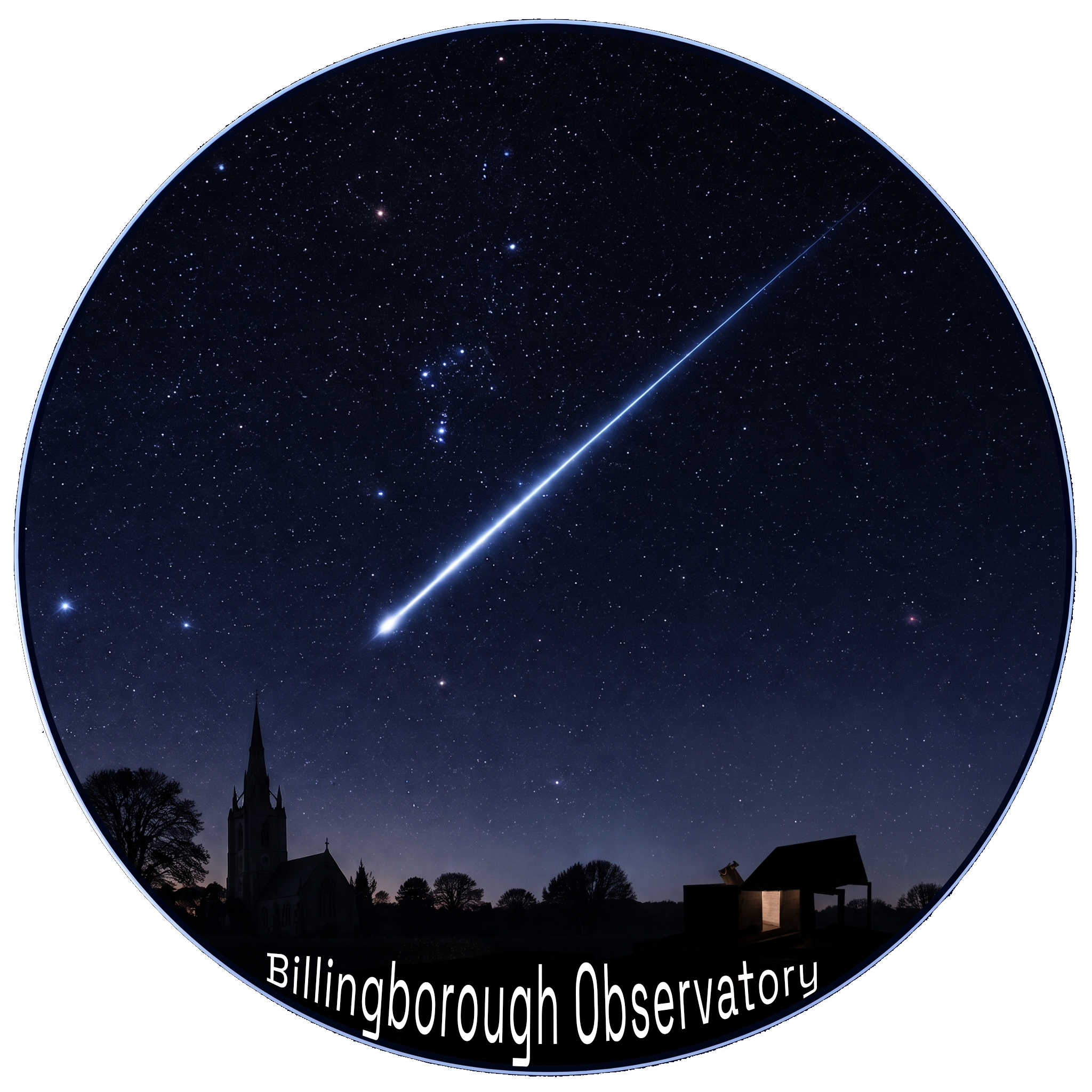
One of the meteor detection cameras operating at Billingborough Observatory. Its observations are processed automatically and contribute to the wider network.
View UK0026 observations →LEARN & EXPLORE
How automated cameras record meteors above Billingborough and contribute observations to a much larger picture of meteor activity across the world.
STARTING WITH THE BASICS
A meteor is the visible streak of light produced when a small piece of material from space enters Earth's atmosphere at high speed.
The object travelling through space is called a meteoroid. The brief flash of light we see in the atmosphere is the meteor. If any surviving material reaches the ground, it is called a meteorite.
Most meteors are fleeting events. They may last only a fraction of a second, making them easy to miss if nobody happens to be looking at exactly the right moment.
An automated camera can keep watching throughout the night, recording events that would otherwise go unnoticed.
BILLINGBOROUGH OBSERVATORY
Billingborough Observatory operates automated meteor detection cameras as part of the Global Meteor Network.
One of the meteor detection cameras operating at Billingborough Observatory. Its observations are processed automatically and contribute to the wider network.
View UK0026 observations →Our second meteor detection camera provides another continuous view of the sky and contributes observations to the same wider network.
View UK0032 observations →HOW IT WORKS
The cameras operate automatically, recording the night sky frame after frame. When a meteor crosses the field of view, it can appear as a short bright streak against the background stars.
The resulting images can then be examined and processed to determine whether a meteor has been recorded and to extract useful information about the event.
This is one of the important advantages of automated observation: the camera can be collecting data while nobody is physically present at the observatory.
REAL OBSERVATIONS
The images below are retrieved directly from the Global Meteor Network's latest observation pages.
Loading latest observation…
Loading latest observation…
A MUCH BIGGER PICTURE
A meteor observed from one camera provides useful information, but observations become much more powerful when they can be compared with observations from other locations.
The Global Meteor Network brings together observations from meteor cameras around the world. By combining data from different observing locations, researchers can study meteor trajectories and the distribution and activity of meteoroids entering Earth's atmosphere.
This means that a meteor recorded above Billingborough is not simply an interesting local event. It can become one observation within a much larger scientific dataset.
Our cameras observe the sky from Lincolnshire, while the data they produce contributes to an international network of meteor observers.
WHAT CAN WE LEARN?
Regular meteor observations can help astronomers investigate how material is distributed through the Solar System and how it enters Earth's atmosphere.
Repeated observations also allow meteor showers and individual meteor events to be studied over time. The more observations that can be collected, the better the overall picture becomes.
For an amateur observatory, this provides an opportunity to take part in genuine astronomical observation rather than simply observing objects for visual enjoyment.
KEEP EXPLORING
The observatory's meteor detection page provides the latest observations from our cameras.
See the latest stacked images from UK0026 and UK0032.
View meteor detection →Discover how our other automated camera records the sky throughout the day and night.
Explore the AllSky camera →Continue exploring the educational guides at Billingborough Observatory.
Return to Learn & Explore →